|
by
Kerry Sharp
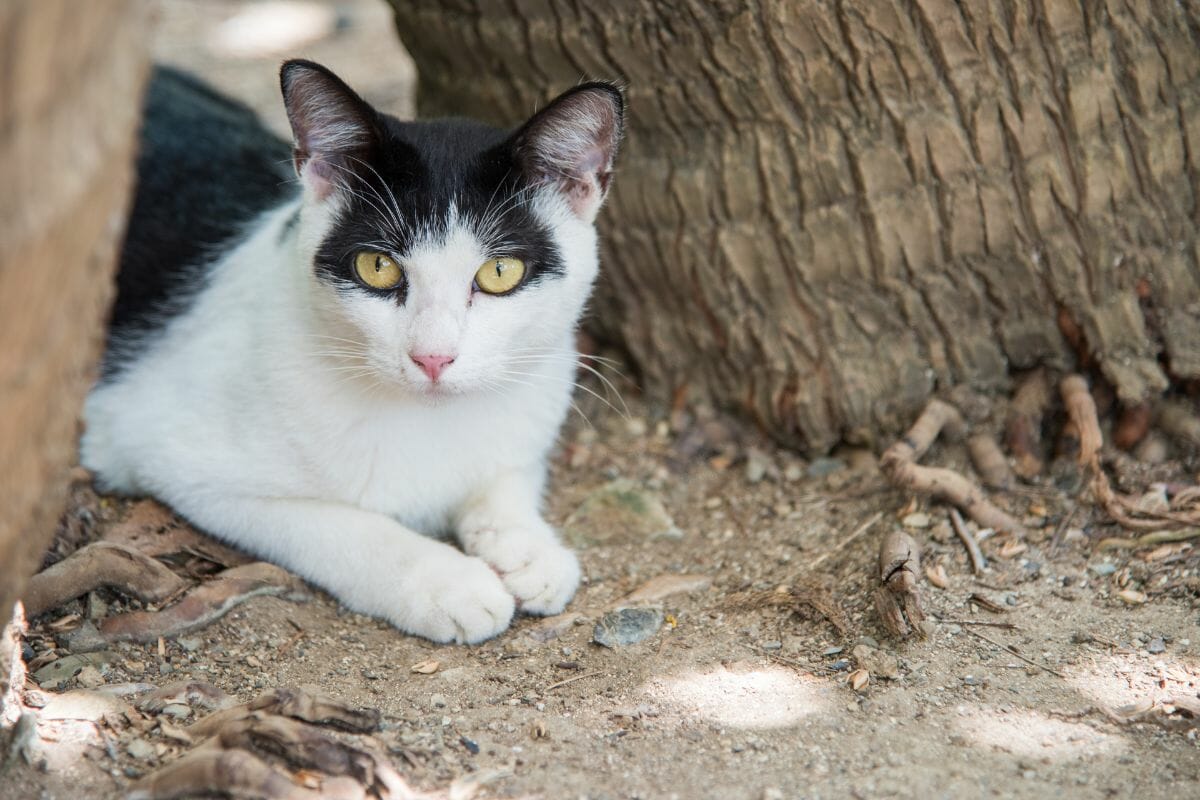
The feral cat is a highly skilled predator with
the ability to survive against the harshest
odds. Researchers believe the Northern
Territory's feral cat population exceeds 100,000
which notch up a staggering annual kill of more
than 36.5 million (36,500,000) small native
animals.
The early ocean travellers to Australia
unwittingly sowed the seeds of an environmental
tragedy when they brought their pet cats ashore.
The subsequent escape or deliberate release of
domestic cats led to free living populations
that now occupy the entire Australian continent
and most of our offshore islands. In contrast
to the milder mannered domestic version, the
feral cat is now ravaging the Australian
bushland and literally eating the heart out of
our native fauna.
To date their has been little research into the
feral cat but the growing body of evidence shows
that Australia's native fauna would now be in
greater numbers with fewer extinctions if the
pet cats of the earliest travellers had never
reached our shores. Australia's native fauna
is paying the tragic price since the arrival of
Europeans about 200 years ago. More than 30
percent of the Northern Territory's desert
dwelling small mammal species have been wiped
out along with several bird species. The
feral cat appears to have played a hand in these
extinctions.
Felis catus
has been prowling the Northern Territory bush
for at least 100 years. No one knows for
certain when it came but it was already here in
appreciable numbers last century when some of
the earliest European expeditions began moving
into this part of the country.
In 1883, the geologist George Winnecke observed
a feral cat near the Queensland border in an
area now encompassed by remote Tobermorey
Station. Later in 1897, British adventurer
and prospector, David Carnegie, while travelling
south east from Halls Creek to Coolgardie via
the Northern Territory - Western Australia
border area, came across two Aboriginal women
hunters at Winnecke Hills, 500km west of Alice
Springs, with a common domestic black cat,
evidently just killed among their takings.
When Charles Chewings led a well-sinking
expedition through the Tanami Desert in 1909, he
found an abundance of feral cats, so plentiful
where they that he referred to one region as
"cat country".
Feral cats seen at those times had colonised the
country independently of humans. Within two
decades of Europeans settling the Northern
Territory, feral cats where many hundreds of
kilometres from the nearest towns and
outstations.
Various theories have suggested feral cats
originated from early shipwrecks along the
Western Australian coast, from the Macassans
sailing south to trade with Top End Aborigines,
or that they were ancestors of the domestic cats
brought north by the Overland Telegraph Line
construction gangs. Whatever their origins,
feral cats have adapted astonishingly well to
our bushlands to become one of this country's
most efficient and skilful hunters in the wild.
Feral cats are robust creatures with the ability
to survive in the most inhospitable
conditions. They are now scattered the length
and breadth of the Northern Territory with large
populations occurring in a diverse range of
habitats. They occur throughout the hot dry
spinifex deserts of central Australia, the
rugged Kimberley Ranges, the Arnhem Land
Wetlands and the steamy mangrove and rainforests
of the tropical north. They also survive in
the streets and alleys of our towns and cities.
"They are the most extraordinary colonisers."
says Dr. Ken Johnson who, as head of the
Conservation Commission's Mala research program
in Central Australia, has tasted the bitter
disappointment that goes hand in hand with feral
cat power.
"I've been working in the Tanami where our
weather station was recording daily temperatures
of 45 degrees, yet the cats were comfortably
surviving without water other than the moisture
they got from mammals, birds and reptiles they
killed at night."
Feral cats are most often seen at night. By
day they tend to hide away in rabbit burrows,
hollow logs or other convenient shelters to
escape the heat of the day and to gather
strength for the nocturnal carnage.
Legend has it that wild cats as big as tigers
are prowling the Australian bush, but legend is
wrong. The feral cat is rarely bigger than
your average domestic cat but its stealth and
speed are just as chilling as those of the
tiger. Little wonder that the feline king's
pint sized cousin has earned itself such an ugly
reputation. Very large cats have been
reported on odd occasions, but generally males
weigh an average of 4kgs and females are around
3kgs. The vast majority of the Northern
Territory's feral cats are tabby in colour with
orange being the next most predominant shade.
These colours probably offer the best camouflage
for cats trying to hunt down their prey.
Depending what is available; the feral cat will
feed on live insects, fish, frogs, reptiles,
birds and native and introduced mammals up to
the size of a Brush-tail Possum. Rabbits
constitute a major food source in Central
Australia. Cats can kill prey up to their own
body size - that puts most of Australia's
endangered and vulnerable mammals, birds and
reptiles in danger. Already there is evidence
of their dramatic impact on the Bilby and Rufous
Hare-wallaby or Mala.
These adept predators are known to prey on more
than 100 native bird species, 50 mammals, 50
reptiles, a number of amphibians and a number of
invertebrates. The list continues to grow as
more data comes to light through wildlife
research programs.
Urban trends have done little to help the
situation. The blame cannot be placed solely
with the unfortunate animals discarded by their
owners to fend for themselves in the bush.
Surveys show that one in every three Australian
household keep a domestic cat and, despite
sufficient food supplied by the owners, their
pets bring home an average five to ten mauled
native birds every year. It is estimated that
in big cities like Melbourne, millions of native
birds are killed annually by cats whose
predatory activities account for most of the
fledglings bred in suburbia each year. Larger
natives such as possums also die in their
thousands every year at the hands (or paws) of
the domestic cat.
There must be more than 100,000 feral cats
roaming the Northern Territory bush (i.e. one
cat for each 13 square kilometres). But even
with this very conservative figure and the
equally conservative figure of one animal killed
each day, it still works out to a staggering
36.5 million native animals killed each year.
The number is undoubtedly much higher. One
cat in the Tanami Desert was found to have eaten
a marsupial mouse, a native rodent, a bird, two
lizards and the front half of a large goanna.
A cat on an island off Western Australia had
devoured an entree of no fewer than nine mice
before 10 o'clock at night.
In May last year, the Endangered Species Unit of
The National Parks and Wildlife Service hosted a
national workshop in Canberra to look at the
impact of feral cats on Australia's native
fauna. There was no argument among
participants that cats represented a significant
threat to fauna. The clear message was that
urgent studies were needed to find ways to
remove the threat. A major recommendation was
that an expert working group, comprising
representatives of Federal, State and Territory
nature conservation agencies and the CSIRO, be
established to target the country's feral cat
dilemma. The group's priority task will be to
develop a national research strategy to better
gauge the impact of feral cats on native flora
and fauna and ecosystems, and to identify ways
to tackle it.
Dr. Johnson and his team are working on a
captive breeding program which one day is
expected to see wild populations of the Mala or
Rufous Hare-wallaby, one of Australia's most
critically endangered native mammals,
re-establish in places where it had become
extinct. The Mala once occupied about 25% of
mainland Australia, from the Northern
Territory's western spinifex deserts and the
North West regions of South Australia, through
to Western Australia's vast spinifex sand dune
country and to the drier wheat belt area east of
Perth.
Today there are no known wild Mala colonies left
on the Australian mainland. Until recently
there were two discrete but neighbouring
populations surviving in the Tanami Desert but
one was extinguished in 1987 in association with
a single fox.
The other was destroyed by wildfire in 1991.
Fortunately a captive colony has been
established in Alice Springs and this now forms
the basis of a project to re-establish free
living wild populations. Significant Mala
populations still exist on protected Dorre and
Bernier Islands off the Western Australian
coast. These wallabies are of the same genus
and species as the mainland Mala, but they are
much bigger darker in colour and being without
natural predators are very quiet compared with
their skittish mainland cousins.
Attempts to reintroduce captive bred Mala into
their former natural habitat in the Tanami
Desert during late 1990 suffered an unexpected
setback. The timid creatures were slaughtered
by feral cats some months after they had
tentatively felt their way back into the wild
and established a breeding population.
"That's when the research team began finding the
partially eaten bodies of Mala that had been
released into the wild from the special desert
enclosure three months earlier." Dr. Johnson
said.
|
Please click on thumbnails to enlarge |
 |
 |
|
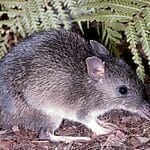
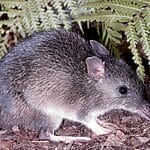
These are recent pictures of a geriatric
Mala (a known 14 years old) at the
National Parks and Wildlife facility at
Monarto, South Australia |
"The Mala had successfully established in the
wild and had raised young over the three months
before the trouble started. Careful
monitoring of the area and assistance in
tracking by local Warlpiri people from Willowra
showed there to be no dingoes or foxes but
several cats in the release area and that the
cats were responsible for the deaths. I was
aware that cats were killers of our native fauna
but I had not expected them to be so
devastatingly efficient."
"It has, nevertheless, been an indisputable
demonstration that feral cats present a serious
threat to the conservation of native fauna, and
it has helped to start the national program to
solve the problem."
Disappointed but undeterred, the Conservation
Commission research team has initiated further
releases in the Tanami since that discovery,
determined to learn from past failures by
adopting methods that could eliminate the
threat. As a result of the ongoing Northern
Territory Mala research effort, there are now 50
healthy, captive bred animals being held at
Alice Springs, at least 60 in a 1sq km enclosure
at the Lander River flood-out north of Willowra
in the eastern Tanami Desert, with 27 free
ranging from that site, and a further 11 near
Sangsters Bore in the southern Tanami.
As masterly as they are at the art of stealth
and predation, feral cats do not have it all
their own way in the Territory bush. Dingoes
eat them when they can catch them and Central
Australian Aborigines historical have regarded
them as an easily attained food source,
especially in the summer months when the felines
could be tracked down to their daytime refuges
from the searing desert heat. The cats,
disease carriers themselves, also must contend
with life threatening blights like bronchitis
and pneumonia and with a whole range of
parasites. Now they face the added threat
from wildlife researches who are determined to
find acceptable methods for controlling feral
cat populations.
A Conservation Commission researcher, Geoff
Lundie-Jenkins, who works on the Central
Australia Mala project at Sangsters Bore, says
there are no suitable techniques available for
combating the cat over vast regions of the
Northern Territory. "The use of poisoned baits
has been successful in reducing the numbers of
dingoes on pastoral lands, but cats are
reluctant to accept such offerings of free
food. Our desert cats in particular tend to
snub the type of food available to their
counterparts in urban areas. They are used to
fending for themselves by living off bush
resources and they favour live prey like small
mammals and birds rather than canned food or
pieces of meat. Conversely, feral cats
inhabiting urban areas are more partial to
favour meat and household scraps."
"We have had success in working with local
Aboriginal people to track down cats to where
they can be shot, but this is very labour
intensive and not a viable solution for large
areas. Survival of the Mala since these
controls have been introduced has nevertheless
shown the worth of such effort."
Geoff Lundie-Jenkins says Northern Territory
circumstances are significantly different to
those in densely populated areas of
Australia. While the Territory has
appreciable cat populations, the opportunities
for control are hampered by limited manpower and
by the animals' spread over such a vast and
remote area. He says there is a real urgency
for feral cat research in this region because of
the race against time to keep more valuable
wildlife species off the extinction list.
Prompted by the concerns of the nations' leading
feral cat authorities at last year's Canberra
workshop, the Australian National Parks and
Wildlife Service has allocated substantial
funding for feral cat research in the next
financial year. This will significantly
assist the existing studies of feral cats.
"It is imperative that we increase our research
effort to find appropriate methods for
controlling cats so that we can get substantial
colonies of our endangered species back thriving
again in their former wild habitats." Geoff
Lundie-Jenkins says.
In the arid mainland desert the best chance of
victory, in the short term, appears to be in the
intensive methods of control so that captive
bred animals like the Mala can build up wild
populations to a stage where they have strength
to withstand introduced ravages. A
corresponding all out offensive against the
feral cat with weapon yet undiscovered, may see
once threatened native species thriving again in
the wild.
Since September last year, Mala released from
their enclosure on Lander River have all
survived. This has been due to a concentrated
effort of trapping and shooting cats in the
vicinity, thereby eliminating many potential
predators. Recently researchers felt their
efforts were being rewarded when they trapped a
female Mala that had been raised to independence
by her mother after release from the
enclosure. She was carrying her own pouch
young.
The Conservation Commission has high hopes for
the success of the Mala program but recognises
that there is still a long way to go and a lot
more to learn before the feral cat is finally
eliminated as a threat to vulnerable native
fauna. That day will mark the beginning of a
very substantial recovery of Australia's native
fauna.
(This article is printed with acknowledgments to
Nature Territory
and the author and was first printed in
‘Keeping Marsupials’ in the early nineties.)
Sad But True
Here is an alarming snippet of trivia!
A feral cat of a little under four kilos had
been shot somewhere in the north of South
Australia and its stomach contents examined.
It contained one house mouse, three striped
skinks, one lined earless dragon, one smooth
earless dragon, three bearded dragons,
twenty-four painted dragons and a zebra
finch. So much for our native wildlife.
The really alarming part of this story is that
all these carcasses were still easily
identifiable, which infers the creatures had
probably been caught in the previous twenty-four
hours. |