These nocturnal creatures are an iconic symbol of the country and well known by all Australians.
Despite being quite solitary and secretive they lead very interesting lives much of which is unknown.
So, we have 5 amazing facts about Brushtail possums that you may not know. Stick around and learn something new about these fascinating animals.
Distribution
Although the Brushtail possum is widely recognized as an Australian animal it is also present in other places.
These include Tasmania, New Zealand, Barrow Island and Kangaroo Island.
Brushies are the most commonly encountered marsupial in Australia due to their abundance and wide distribution.
There are actually 23 species of possum in Australia with the Brushtail possum and the Ringtail possum being the two most common.
As they typically live in dreys which they build in tall trees, the deforestation of large parts of the country has meant that Brushtail possums come into more regular contact with people.
They are gentle creatures and not aggressive towards humans, but it is their choice of alternative home that can cause them to become a nuisance.
Brushtail Possum Homes
Without suitable trees to live in and their wide distribution across the country it is not surprising that Brushies have moved into people’s homes.
Roof spaces make a good alternative to a tree home. This can cause problems for the inhabitants of the house.
As Brushtail possums are nocturnal they move around a lot at night. With that kind of noise going on above your head it’s going to be difficult to get to sleep.
However, it is illegal to trap or kill a possum, so the only answer is to call a possum relocator.
Relocating A Brushtail Possum
Unfortunately, even a relocator can only move the Brushtail possums a short distance from your home.
This is because if they are moved further away from their choice of home they may die.
So even if they are removed from the roof space and relocated, chances are they will come back.
In this case your best option is to buy or build a purpose built possum house and put it in your yard, away from your roof space.
This should be high enough to keep it out of the reach of dogs and cats.
As Brushtail possums are so widely distributed across Australia, there is a good chance that you may encounter one, so it is important to understand their behavior and the law related to their treatment.
Natural Habitat
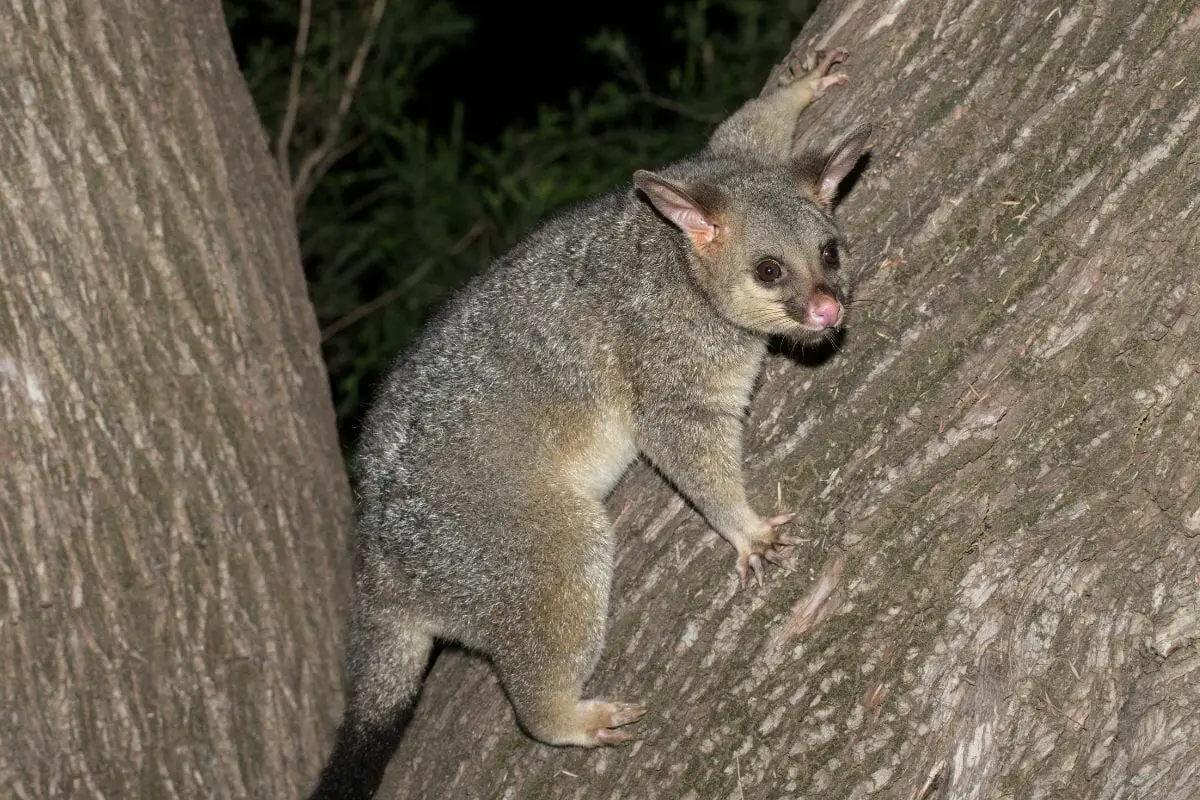
As we have seen, a Brushtail’s natural home is in a tall tree where they build a drey, their nest.
The choice of location is varied and can include woodland, pine plantations, dry eucalyptus forest, cultivated areas, savanna, and even rural gardens.
These habitats can be along the coasts, or inland along the banks of rivers or creeks.
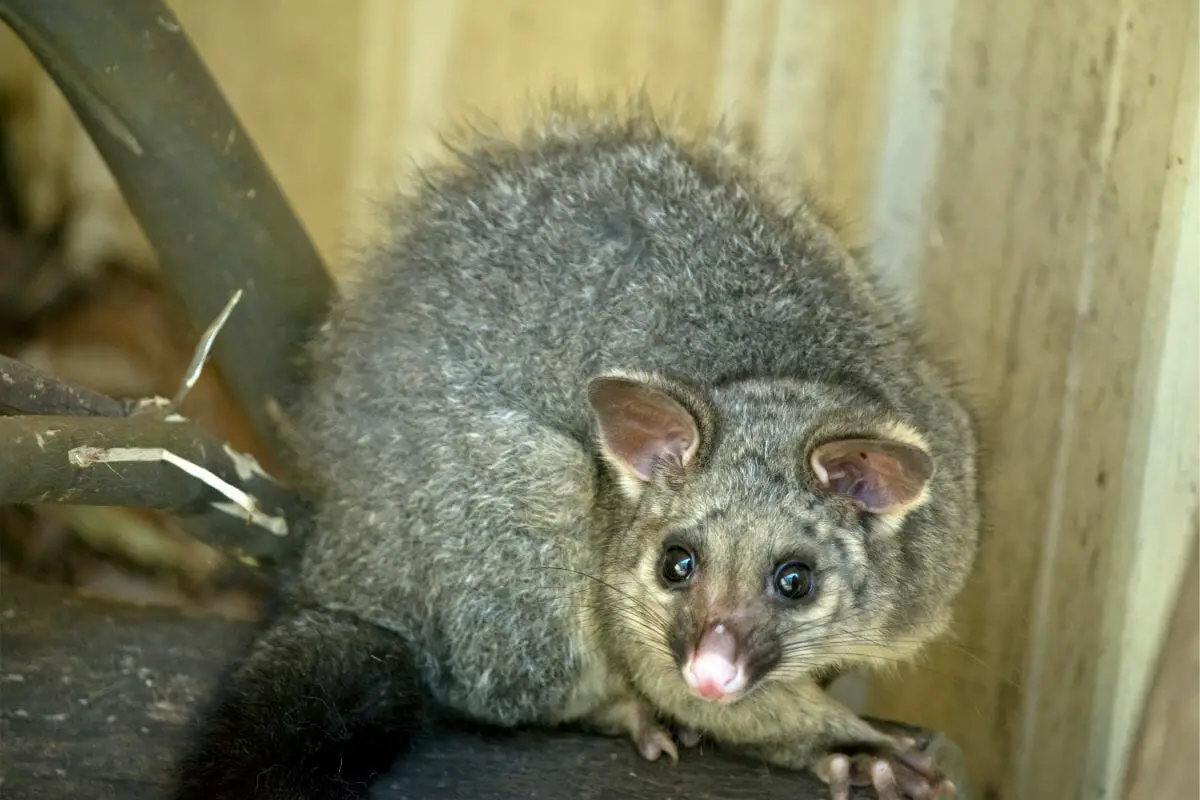
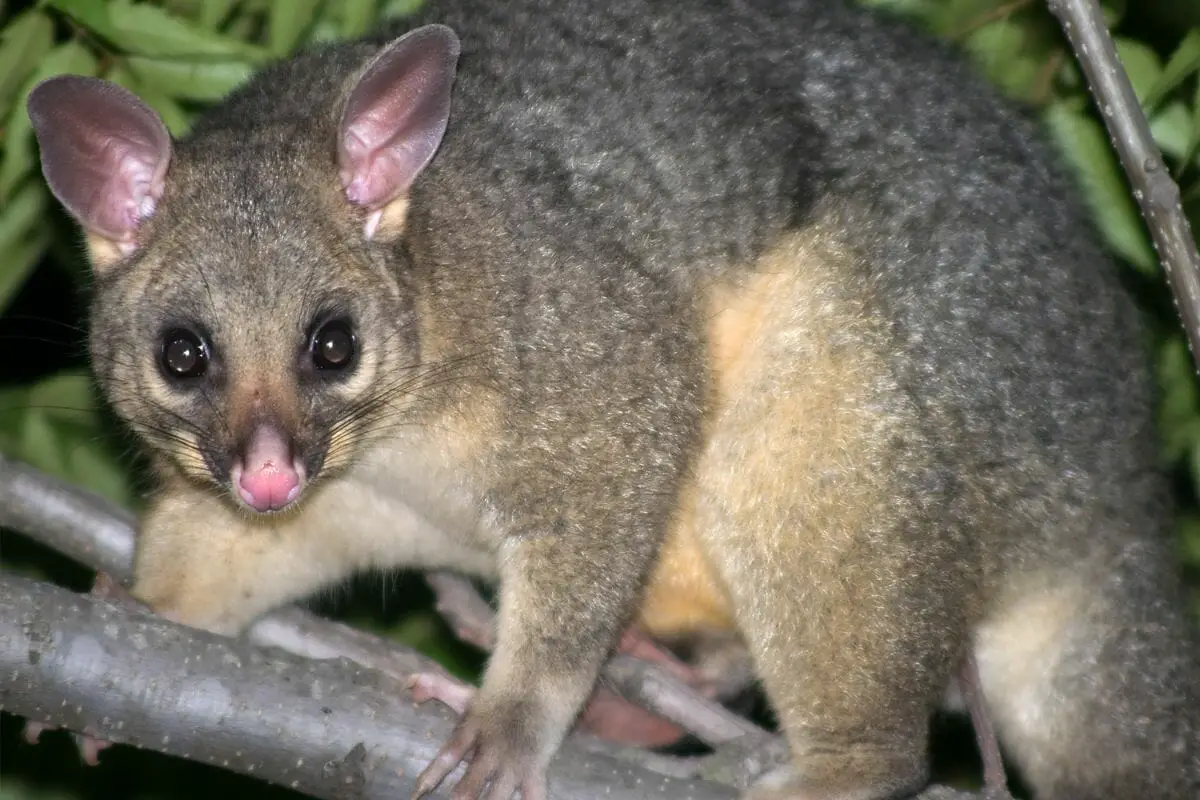
The Brushtail possum is about the size of a domestic cat.
It has large eyes which help it to see in the dark so that it can feed and move around at night. During the day the possum will typically sleep.
These are very vocal creatures who have a repertoire of sounds such as clicks, grunts, chatter, alarm calls and hisses which they use to communicate with each other.
Large pointed ears make it easier for them to hear one another as well as any potential threat.
To help them climb trees in their natural habitat Brushies have a bushy tail with a prehensile tip which is perfectly adapted to grasping branches.
The underside of their tail is bare making it grip better.
Sharp claws on their fore feet also aid good grip, and they have a clawless toe on their hind feet which is very strong.
The other hind toes are fused together making them perfect for grooming.
Diet
A Brushtail possum’s typical diet consists of leaves, shoots, flowers, buds, fruit and vegetables, although they are known to also eat insects.
However, their favorite food is Eucalyptus leaves.
They have strong teeth and hold their food in their front paws as they eat.
In urban areas the common Brushtail possum will often raid people’s gardens and eat their vegetables and fruit.
Another reason that they are often considered pests in towns and cities.
With their rounded molars Brushies are more adept at chewing soft food such as fruit and vegetables.
They will also eat bird’s eggs and smaller invertebrates as these are softer foods for them.
These types of foods also contain protein which the Brushtail possum needs as it cannot get enough of this nutrient from eating Eucalyptus or other vegetation.
However, its mixed diet does provide plenty of nitrogen for the possum.
As they forage for food they will eat a variety of plants and leaves unlike other arboreal marsupials like Koalas who tend to stick to just eating one species, usually Eucalyptus.
Mating Habits
Common Brushtail possums display polygynandrous mating behavior. This means they are promiscuous and both males and females will mate with several different individuals.
Although they can breed at any time of the year there tend to be peak breeding times, in the spring from September to November and in the autumn from March to May.
The timing of mating can vary depending on location with slightly different breeding seasons in the north of Australia.
In one Queensland study of Brushtail possums it was found that the males had to consort with the females for about a month before they would be allowed to mate.
Some males can sire several offspring while around half will not succeed in siring any young possums.
Young Brushtail Possums
Once the female is impregnated the gestation period is very short, just 16-18 days.
While this may seem remarkably short, remember Brushtail possums are marsupials.
So when the young Brushtail possum is born it will crawl unaided through the mother’s fur and into her pouch.
The baby possum will immediately attach itself to the mother’s teat and remain there for 4-5 months, where it will continue to grow and develop.
Only one young Brushtail possum is born at any given time and measures just 1.5 centimeters long. It will weigh only 2 grams.
After several months the young Brushtail possum will emerge from its mother’s pouch and either remain in the nest or travel on the mother’s back.
This continues until the baby possum is around 7-9 months old.
Breeding
Female possums reach sexual maturity when they are just a year old while males reach this point at the end of their second year. In the wild, Brushtail possums can live up to thirteen years of age.
It has been noted that young female possums have a greater survival rate than their male counterparts.
This could be due to the fact that males tend to wander further in search of new nesting sites and may experience forcible resistance from already occupied territories.
However, it is also thought that females tend to stay close to their mother and benefit from the already claimed territory and so face no outside opposition to their presence.
Although there may be competition between mothers and daughters in areas with a shortage of nesting sites.
In these areas Brushtail possums have been known to produce less female offspring while in regions with lots of nesting options they produce more males.
Population
As with so many native species the common Brushtail possum is suffering from the loss of its natural habitat and its numbers are declining.
However it is still widespread throughout Australia and is listed as LC (least concern) on the IUCN Red List.
The IUCN (International Union for Conservation of Nature) Red List of threatened species is an indicator of the health of the world’s biodiversity.
Despite once being hunted for their fur the Brushtail possum is now protected in Australia. In Tasmania, this possum is partially protected and there is still an annual hunt.
Farmers in Tasmania can also obtain a Crop Protection Permit to try and control the damage done by them.
In New Zealand the common Brushtail possum is thriving and there is no protection here and no restrictions on hunting.
Many of them are killed every year in New Zealand. Despite this the population of this possum shows no signs of declining.
There are no definitive figures on the number of Brushtail possums in Australia or its other locations.
However, the fact that it is registered as an animal of least concern on the IUCN Red List is encouraging.
Even though there is destruction of its natural habitat this marsupial is highly adaptable and is capable of thriving in suburban and even urban areas.
Final Thoughts
The more we understand about these native creatures the more we can help them to thrive and keep them off the list of endangered species in Australia.
We hope you have enjoyed our guide to the common Brushtail possum and have found it helpful.
Hi, I’m Olivia Kepner and I am a zookeeper here in San Diego. Since I was a young girl I have always been fascinated by animals and species across the globe.
I used to beg my parents to take me to our local zoo every single weekend. Well, I say local – it was more like a two hour drive away. But they took me as much as they could, allowing me to fall in love with the animals again and again.
We use cookies to ensure that we give you the best experience on our website. If you continue to use this site we will assume that you are happy with it.OkPrivacy policy